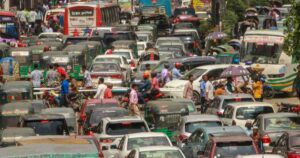

13 pioneering mayors have committed to the Green and Healthy Streets Declaration pledging to procure only zero-emission buses from 2025 and ensure that a major area of their city is zero emission by 2030. Signatories to the Green and Healthy Streets Declaration “envision a future where walking, cycling, and shared transport are how the majority of citizens move around our cities.”
The cities are London, Paris, Los Angeles, Copenhagen, Barcelona, Quito, Vancouver, Mexico City, Milan, Rome, Seattle, Auckland & Cape Town.Analysis by C40 found that these policies could add 3 weeks to average life expectancy of every citizen of Paris and could prevent 45,000 premature deaths globally each year
2. Cities have committed to restricting the most polluting vehicles.
The mayors of Paris, Mexico City, Rome, and Copenhagen have made commitments to prevent diesel vehicles from entering their city centres. Oslo is working towards restricting the number of vehicles in the city centre to the lowest number possible by 2019.
3. Cities are prioritising their streets for walkers and cyclists
The mayors of many C40 cities around the world are taking action to regularly give the streets back to pedestrians and cyclists.
• In Paris, once per month the Champs Elysees is closed to traffic, giving the iconic route back to pedestrians and cyclists. In 2017, a 3km section of the right bank of the Seine, that was previously a two-lane motorway, has been pedestrianised.
• Mayor of Rome, Virginia Raggi announced just this week that 24km of Rome’s streets will be closed to cars one Sunday per month, inspired by a similar scheme she witnessed first-hand during a C40 conference in Mexico City.
• In Bogota, more than 70km of roads are closed to cars every Sunday, with more than 1 million people taking to their bikes each week.
4. Peter Sagan & Arnold Schwarzenegger endorse cycling to work
World Champion cyclist Peter Sagan, Former Governor of California Arnold Schwarzenegger and Mayor of Paris, Anne Hidalgo came together, in person and digitally, to endorse cycling to work as the best option for improving air quality and preventing climate change.
5. New report shows some electric buses already cheaper to run than conventional buses
Research by C40 and Bloomberg New Energy Finance found that total lifetime costs of electric buses can already be a cheaper option for cities compared to conventional buses today.
6. London’s package of air quality measures.
• A £10 Emissions Surcharge (dubbed the ‘T-Charge’) on the most polluting vehicles entering central London during Congestion Charge hours – operating since October 2017;
• Implementing the world’s first Ultra Low Emission Zone (ULEZ) from 8 April 2019.
• Implementing 12 clean bus corridors by 2020
• Only purchasing electric, hybrid and hydrogen double-deck buses from January 2018 – phasing out diesel. All single-deck buses to be zero emission by 2020;
• A “Newer Vehicle Checker” to provide Londoners with a tool to check the NOx levels of new cars before they buy – operating since October 2017. London is currently developing the “Used Vehicle Checker” to check older vehicles, and the “Cleaner Fleet Checker.”
• London is piloting a hyper-local monitoring system which will grow the city’s sensors from roughly 100 to over 1,000. The aim is to collect data on a street-by-street basis to give Londoners a more accurate analysis of air pollution concentrations across the city.
7. Chinese cities, like Shenzhen, leading the roll out of electric bus fleets.
99 percent of the world’s 385,000 electric buses are on the roads of Chinese cities, accounting for 17 percent of the country’s entire fleet. Every five weeks, Chinese cities add 9,500 zero-emissions buses—the equivalent of London’s entire working fleet – according to Bloomberg.
In 2009, Shenzhen was approved by the central government to be one of several cities for piloting new energy vehicle technology and infrastructure. The city’s strategy has been to prioritise electrified public transportation (buses and taxis), and then gradually transition private cars as well. As of January 2018, the entire public bus fleet – 16,359 – are fully electric. The next target is to convert all its 17,000 taxis to electric by 2020. Shenzhen was recently ranked in the top 10 for best air quality in China, according to China’s Environment Agency.
8. Barcelona’s Superblocks
Superblocks make use of Barcelona’s grid based road layout, restricting traffic to the outer perimeter of the block and giving preference to pedestrian and cycle traffic in the central roads. Though the inner streets are generally reserved for pedestrians, they can be used by residential traffic, services, emergency vehicles, and unloading vehicles under special circumstances. The result from several years of pilot schemes suggests that air quality, public health, and local trade all improve on the streets within the superblock.
9. Los Angeles citizens voted to increase their taxes to spend on sustainable infrastructure.
LA is dropping its reputation as the car capital of USA, and making huge investments in sustainable infrastructure and alternative transport options. In November 70% of voters approved Measure M, a permanent sales tax increase to fund a major expansion of the county’s public transit system.
10. Tokyo’s pollution police
Japan’s emission control requirements for vehicles are the strictest in Asia and among the strictest in the world, which means there are very few diesel or high polluting cars on the roads of Japanese cities. To ensure these regulations are effectively enforced, a team of automobile pollution inspectors, mainly former police officers, are dispatched to identify vehicles in violation. Enforcement by the team includes inspections of vehicles on the street and at distribution centres, and the use of video cameras to record vehicles driving in Tokyo. Violators are subject to an order prohibiting operation of the vehicle, followed by a fine for repeat offenders.
Source: C40 Cities Climate Leadership Group