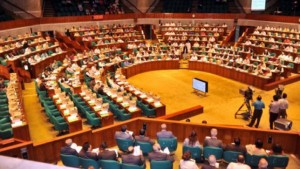
Dhaka, June 7 – Finance Minister Abul Maal Abdul Muhith apparently dipped into his party’s electoral playbook to design the national budget for 2018-19 fiscal, which experts dubbed as a populist and election-centric budget. It’s all about understanding the political economy and delivering a sharp message, they said after the 84-year-old minister who stood at the front row in the national parliament to place the budget for the record tenth consecutive times yesterday.
The minister himself didn’t shy away from seeking another term for the ruling Awami League while presenting the proposed budget for the FY 19, titled “Bangladesh on a Pathway to Prosperity”.
With the national election scheduled at the yearend, the Awami League government’s lofty promises in the budget are largely targeted at a wide base of lower and lower-middle-class voters, while milking resources from the urban middle and upper class to meet its political ends.
A loosened grip on VAT regime and reduction of nine truncated VAT rates down to five rates is an indicator of the government‘s intention of giving a respite to any consumer class but a status quo in slabs of the tax-free income comes as a surprise as pre-election discussion hinted a change there.
Explaining, Muhith said at the parliament, “The increase of tax exemption threshold puts a significant number of taxpayers out of the tax net.” He also informed that in Bangladesh, tax exemption threshold is almost 200 percent of per capita GDP whereas, in the developed countries, it is generally less than 25 percent of per capita GDP.
Dr Taslim Ahmed, Professor of Economics of Dhaka University, however, said his reluctance in broadening the tax-free income net is understandable, as a for a budget of Tk. 4,64,573 crore—the largest in the country’s history which is 16 percent larger than the last one—the government needs to rely heavily on income tax and other duties to fulfill its revenue collection target.
The government has set a revenue collection target of Tk.3,39,280 crore, out of which, Tk 2,96,201 crore is planned to be collected in different forms of taxes and duties. The largest revenue collection target is from VAT – Tk 1,10,543 crore while the second largest is from income tax and other direct taxes—Tk 1,02,201 crore
In the outgoing fiscal these numbers were respectively Tk 83,702 crore and Tk 78,000 crore. So this year’s targeted number indicates a staggering 32 percent and 31 percent targeted growth respectively. Dr Ahmed said, with crowd-pleasing VAT measures and slow growth in income tax providers, sourcing such revenue would not be a cakewalk for the government.
The Finance Minister begged to differ. In the parliament, he said, “We are very much on the track of achieving that target. Even one decade back, the contribution of income tax was only 20 percent of the total NBR revenue; the contribution has increased to 35 percent during our government.”
He also said, since 2011, the number of taxpayers has tripled and the number of return filers has increased from nine lakh to almost 16 lakh. “Observing this positive trend in tax compliance, I am setting the target to increase the number of registered taxpayers to 1 crore and the number of return filers to 80 lakh within next 5 years,” said Muhith in Parliament.
The budget deficit this year will be Tk.1,25,293 crore which is 4.9 percent of GDP, up from 4.76 percent of the FY 18. Of this, an amount of Tk.54,067 crore (2.1 percent of GDP) will be financed from external sources while an amount of Tk.71,226 crore (2.8 percent of GDP)will be financed from domestic sources.
Muhit said, elaborating on the domestic sources, that Tk.42,029 crore (1.7 percent of GDP) will be borrowed from the banking system while Tk.29,197 crore (1.2 percent of GDP) from National Savings Schemes and other non-bank sources.
Former Bangladesh Bank Deputy Governor Rumee Ali said with a prevailing absence of accountability, and growth of non-performing loans the banking sector is still suffering. Also, it hasn’t recovered from a sudden and unwanted liquidity crisis and relatively lower lending growth rate, he said.
“So borrowing such a large amount from the bank will be tough. The government probably would take more money from the saving certificate like the way it did in the last fiscal,” said Ali.
Muhith too acknowledged this in his speech. He said in recent times, imbalance of liquidity in money market together with problems with the management of a few banks created worries. The situation, however “is now under control for the timely steps we have taken,” he said.
According to the Finance Minister by the end of April 2018, the growth of broad money and domestic credit growth stood at 9.1 and 14.4 percent respectively which are very much within the targets set out in the monetary policy statement of the Bangladesh Bank.
He, however, proposed to reduce the tax rate for banks and financial institutions by 2.5 percent. “This will give a positive signal to our investors,” he said.
For the FY 19, Muhit has set an overall growth target of 7.8 percent for the economy. In the outgoing fiscal growth target was 7.4 percent, and Muhith reported that according to final estimates of the Bangladesh Bureau of Statistics (BBS), growth stood at 7.65 percent.
Khondokar Golam Moazzem, Research Director of Center for Policy Dialogue (CPD) however believes “this growth wouldn’t yield the desired benefit unless the government ensures a sustainable growth rate in employment as well.”
According to him, the above seven percent GDP growth could not lift income of labors rather average real monthly income eroded by 2.50 percent in the ongoing fiscal despite the increase in employment.
“Decent job creation is now more important than achieving GDP growth at a higher rate,” said Dr Moazzem, “As currently jobs are mostly created in the informal sector where wages are very low.”
The CPD researcher said that the ongoing fiscal hasn’t seen any significantly large investment from the private players. “In the proposed budget, I didn’t see any innovative measures to rope a large number of new investors. So, I think it will be hard to attain the 7.8 percent growth.”
On the expenditure side, the Non-development expenditure in the budget for FY 19 amounts Tk 2,95,200 crore has eaten up about 62 percent of Tk 4,64,573 crore total expenditure out of which Tk 66,224 crore will be spent on government salaries and allowances. Another Tk 51,335 crore will be spent on interest on government loans.
The size of the Annual Development Programme (ADP) will be Tk 1,73,000 crore. Muhith said, of the total ADP allocation, he proposes to allocate 26.percentnt for human resources development (education, health and others), 21.8 per cent for overall agriculture (agriculture, rural development and rural institutions, water resources and others), 14.3 per cent for power and energy, 26.3 per cent for communication (roads, railways, bridges and others) and 10.8 per cent for other sectors
Former advisor of the caretaker government Dr Mirza Azizul Islam told The Independent that the governments in Bangladesh historically have a tendency to take more project than it can implement in the ADP,” he said, “Also they take unusually long period in implementing those.” – Staff Reporter