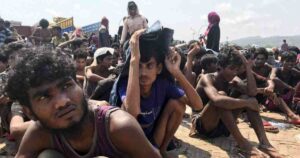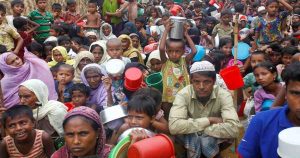

India remains highly supportive to ensure the safe return of Rohingyas to their homeland but does not support any forceful approach that might turn counterproductive, said a highly placed diplomatic source.
“We’ll continue to support this effort. But if you take any forceful approach, it’ll be counterproductive,” the source told UNB on Wednesday wishing anonymity.
Though there has been confusion over India’s position regarding Rohingya issue, Indian External Affairs Minister Sushma Swaraj, during her Dhaka visit, made it clear that normalcy over the Rohingya issue will be restored only with the return of the displaced people to Rakhine state.
“She made it clear they (Rohingyas) should return…they should be repatriated,” the source added.
India thinks it will be difficult to repatriate Rohingyas without ensuring a congenial environment.
In India’s view, the only long-term solution to the situation in Rakhine State is rapid socio-economic and infrastructure development that would have a positive impact on all the communities living in the State.
Diplomatic sources said India wants to focus on ‘immediate issues’ keeping in mind the consequences of delay in repatriation of Rohingyas. Over 6 lakh Rohingyas entered Bangladesh since August 25.
India has also supported the implementation of the recommendations contained in the Kofi Annan led Special Advisory Commission report on Rakhine State.
“You know this (Rohingya) issue came up broadly during her (Sushma) visit,” another diplomat told UNB saying there is no difference in using ‘displaced’ people or Rohingyas.
“You government is also using it (forcibly displaced nationals from Myanmar). We’re using the same. There’s no difference,” he said.
On political issue, he said the Indian External Affairs Minister made it clear that India wants free, fair and participatory elections in Bangladesh.
“It’s clear. India wants to see free, fair and participatory elections and democratic process works,” another diplomatic source told UNB mentioning that it is not for India to say it is legal or illegal but it is for the people [of Bangladesh] to determine.
The source said India does not want to support something that contradicts with the established democratic system.
Asked about the outstanding issue between Bangladesh and India, a senior official at the Foreign Ministry told UNB that the Teesta issue came up for discussion. “Yes, Teesta issue did come up for discussion.”
“We’re working on that. There’s something happening that I can’t tell you now. In diplomacy, you can’t give details before it happens,” said the official.
During her Dhaka visit, Indian External Affairs Minister assured Bangladesh of resolving all the pending issues as Bangladesh has long been waiting to see the signing of Teesta water sharing deal.
“We’re aware of the outstanding issues. We assure you that we’re working to resolve them,” she said.
Foreign Minister AH Mahmood Ali said water resources must act as a ‘uniting force’ between the two countries.
“We discussed the issue of sharing of water of common rivers, including the signing of Teesta Water sharing agreement,” he said.
The two ministers also recalled the statement by Prime Minister Narendra Modi on April 8 that the Teesta agreement will be signed during the current tenure of Prime Minister Sheikh Hasina and Prime Minister Modi.
Sushma Swaraj visited Dhaka on October 22-23 and held the fourth Joint Consultative Commission (JCC) meeting with her Bangladesh counterpart.