
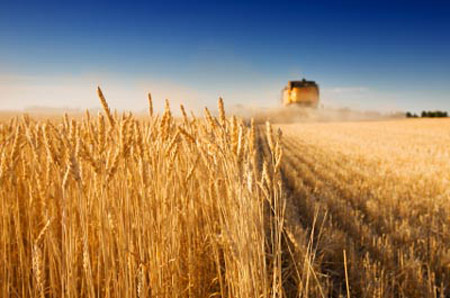
Expansion of wheat farming can mitigate the existing water-stress condition in the high Barind tract as wheat is an environment friendly crop, experts said here Tuesday.
They viewed time has come to enhance acreage of wheat farming instead of only depending on Irri-boro rice in the dried area to ensure food security amid the adverse impact of climate change.
Apart from this, they said about seven to eight bighas of wheat could be cultivated with the irrigated water of only one bigha of boro rice through soil moisture utilization and the best uses of the modern technologies.
Agriculturist Abu Muhammad Musa identically said the adverse impact of climate change has been posing a serious threat to the irrigation dependent crops, particularly Irri-boro rice, as both the underground and surface water resources are gradually declining.
Impact of climate change on ecology is manifold. It affects soil salinity, drought, crop survival, irrigation economy, fresh water availability and so on.
Quoting research findings on the issue, he said the dried area comprising Rajshahi, Chapainawabgonj and Naogaon districts has been seeing drought conditions with gradual increase of extreme weather conditions, sharp declining in groundwater table and decreasing rate of rainfall.
Dr Jalal Uddin, Director of Wheat Research Station, said wheat plays an important role to ensure food security as its consumption is increasing day by day. But, Bangladesh produces hardly 10 lakh metric tons of wheat against the demand of around 40 lakh tons annually, he stated.
He, however, said that Rajshahi region contributes 35 percent of total area and 44 percent of total production. Not only that, there are around 50,000 hectares of more rain fed land in the high barind area and there has been a bright prospects of bringing the huge land under wheat cultivation.
Dr Ilias Hossain, Senior Scientific Officer of Regional Wheat Research Center, views water shortage is gradually becoming acute in the drought- prone Barind area due to scanty rainfall and excessive extraction of groundwater for irrigation as well as adverse impacts of the climate change.
Simultaneously, the unprecedented fall of water level in the river Padma and its tributaries and other wetlands has created an adverse impact on livelihood of people especially the farmers and other marginal groups.
To address the odd situation, more emphasis should be given on expansion of short duration and high-yielding wheat varieties. Seed preservation and production training need to be strengthened. GO-NGO collaboration has become an urgent need for the new variety expansion.
The climate change has been acknowledged as the depletion of natural resources and as a major threat to the agriculture system.
There is no alternative to disseminating ideas of modern technologies among the field level agricultural officials and farmers regarding expansion of wheat cultivation in the drought-prone areas. -BSS, Rajshahi