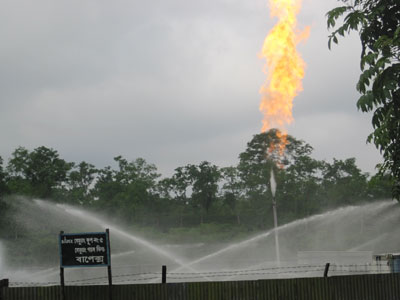
The country is likely to get 300 million cubic feet of new gas per
day (mmcfd) from Chevron’s ongoing expansion project at Bibiyana
field. Sources at the energy sector said the US-based international
oil company’s $500-million expansion work is nearing its target and
expected to be completed by the end of 2014, raising the prospect of
getting new gas. According to the sources, over 60 percent of the
expansion has so far been completed. Officials believe that the bulk
new gas will play a major role in resolving the country’s nagging
energy crisis for which many industries and power sector are suffering
a lot. Last year, Chevron announced the Bibiyana expansion plan —
the processing plant adding two new trains with capacity of 150 mmcfd
each and setting up of enhanced gas-to-liquids recovery unit and
drilling of four new development wells. In addition to the four new
wells under the expansion project, Chevron is also engaged in drilling
another seven new development wells. Of the seven wells, six have been
completed and one is currently underway. However, the benefit of
Chevron’s new gas delivery will largely depend on timely completion of
Bibiyana-Dhanua pipeline, now being implemented by the state-owned Gas
Transmission Company Limited (GTCL). Talking about the gas pipeline
project as the largest one in the subcontinent, Petrobangla chairman
Dr Hussain Monsur said he is hopeful of completing its construction
work by next year. According to Petrobangla’s website, Bibiyana is
the largest gas-producing field currently producing 850 mmcf gas per
day among the country’s total 22 gas fields. The expansion
programme, considered as the largest foreign investment project in the
country’s energy history, is expected to increase Bibiyana’s
production by 35 percent. This will also boost production of 4,000
barrels of liquid fuel (condensate) worth about $175MM a year at the
current import prices. Energy experts believe that completion of
such a large scale project on schedule is always challenging. Because,
it involves construction activities on a brownfield site having a live
operating plant adjacent to it. Maintaining incident and injury free
operations is the key of the challenge. Chevron Bangladesh chief
Geoff Strong said, “Safety is at the heart of everything we do at
Chevron. We’ve achieved 2 million man-hours of work without recordable
injuries on this project alone. This is a lot to be proud of”.
Petrobangla had initially requested Chevron to supply 600 mmcfd new
gas from the field but the IOC agreed to provide half of its request
300 mmcfd gas. Mentioning the project as most significant, Geoff
Strong said that this will add 300 mmcfd to the national gas supply.
“I can’t tell you how proud I’m to be associated with a project that
will not only make a significant impact in the nation’s energy sector,
but will also help drive the growth of a thriving economy”. Strong
said Bibiyana will play a crucial role in Bangladesh’s energy security
for many years to come. “This flagship project will provide more
affordable energy that will not only increase Chevron’s business in
Bangladesh, but will also help drive economic growth. So, this project
is a big win for everyone involved.” He appreciated Petrobangla and
other government agencies for their continuous support to the
expansion work. Sources said at its peak, approximately 1,000
on-site workers from different disciplines including welders,
electricians, crane-operators, cooks, security-guards get involved in
a whole gamut of mechanical, civil and other activities. About 85
percent of the site workforce is Bangladeshi nationals and Chevron has
taken measures to provide comprehensive safety training for all of
them. Projects portfolio manager Mike Smith said completing a
capital-intensive, highly technical project of this massive scale in
less than 30 months brings with it all sorts of challenges. “We’re
working in a rural setting, engaging large numbers of people who have
had no prior exposure to industrial activities. Keeping everybody in
safe everyday while executing this project and providing gas to
Bangladesh on time is our primary goal.” – UNB