Mostafa Kamal Majumder
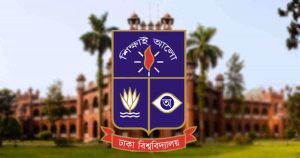
Dhaka College wore a festive look one day with posters of candidates contesting the students’ union election hanging from ropes tied to temporary poles from the main gate to the college building and on two sides of corridors. Most probably that was in 1968 the second student union election we faced during our two memorable years in one of the finest institutions of learning in our country. It was the Election Day. The contesting candidates were mainly from the East Pakistan Student League and the East Pakistan Student Union. The festive mood in the campus touched us all. Suddenly Principal Jalaluddin Ahmed started chasing one of our mates for committing an offence of chanting a slogan – ‘eeepsuu’ which was popular among East Pakistan Student Union members. Principal Sir was so furious that he was determined to catch the man who ran crisscrossing other mates standing on the way, went upstairs and then came down before mixing again with crowds of students in the ground floor. He escaped. The Principal’s bodyguard, a tall and stocky non-Bangalee man in his fifties with a turban on head, could not match his boss in speed and lost track of him. The bodyguard was moving aimlessly to locate the Principal who finally came down the first floor, his face turning red with anger for his failure to catch the disobedient student who dared raise a slogan ignoring a prior order. Jalal Sir could have met with an accident from the run at a speed that did not suit his age.
Students were advised not to paste posters on walls, and ropes were tied up on two sides of the corridors most probably by the college authority to hang campaign papers only for the election time. The student Union election was then President Ayub Khan’s ‘Basic Democracy’-type. We used to elect one representative from each section. There were two sections each group – Humanities, Commerce and Science in every session at the college. The elected representatives then used to elect the college central students’ union leaders. In our Section – A of Humanities group, we elected exceptionally meritorious Abdullah Shibli as our representative for the first year. Sheikh Kamal was our representative in the second year.
We had in our midst most of the top scorers in Secondary School Certificate Examinations from almost all the four education boards at that time. As newcomer to an urban college from Raghunathpur High School in a remote rural village in Kachua Thana of then Chandpur Sub-Division (now district), I at the beginning was shy mixing with other mates. Same was the case with my elder brother Matiul Islam Majumder who was admitted to the Commerce Group. As time passed I developed cordial relationships with many of my classmates. I had a number of indoor games, especially table tennis, partners – Masud, Siraj, Bashir, Ahmedullah and Rumi most intimate among them. To play table tennis sometimes I even skipped classes. The friendship built then lasted in Dhaka University and in the subsequent part of our life. We are proud of each other.
We were lucky to be in the institution where a congenial academic atmosphere was upheld by our honorable teachers. Abdullah Abu Sayeed, now most famous as the founder of the Bishwo Shahitto Kendro, in the course of sharing pleasantries with some of us recently said how Jalal Sir picked him up as a teacher of the Dhaka College. For some reason Abu Sayeed Sir, then a teacher of Intermediate Technical College, Dhaka, faced an interview. Jalal Sir was in the interview board and observed him with his keen eyes. The next day Abu Sayeed Sir found the Dhaka College principal loitering in the Intermediate Technical College corridor. Walking up to him Abu Sayeed Sir asked, who do you look for? In reply Jalal Sir exclaimed, ‘paiya gechi’ (I got it). He instantly offered Abdullah Abu Sayeed a job in Dhaka College and brought him there. Abu Sayeed Sir said, Principal Jalaluddin Ahmed could have chosen to go to the ITC Principal’s room and call him there. But he avoided formality and instead chose to ‘find me out himself’.
This was the inside of a man who was otherwise called a ‘terror’ for his strict maintenance of discipline and supervision of the quality of instructions in the college which, he himself was proud of. In rare rebuke one or two erring students for not observing discipline Principal Jalaluddin Ahmed used to utter, don’t forget, ‘This is Dacca College’. (Spelling changed to Dhaka in the eighties).
For some reasons I do not remember now, I attended only one class taken by famous novelist Shawkat Osman. Most possibly there was no class schedule of our section with him. He came to our class one day in his majestic style and said he would not teach any lesson from the book. He concentrated on ‘adda’ (gossip) and discussed what it means, its topic not remaining focused on any specific subject, thing or idea. He said ‘adda’ is necessary for students like us to share ideas. He advised us not to remain bookish but also to socialise and, whenever possible, join ‘adda’. Abdullah Abu Sayeed Sir followed a similar style in the class room and was very cordial with students. He always had smile in his face and discussed things that we see and experience around us with humour and drew interesting conclusions.
We were proud to have the best teachers in our college. Many of them became principals of government colleges or joined universities in their later life. Among them Noman sir was very eager to ensure that we did not miss points from his lecture. He even used the black board to explain lesson in the English literature class. Of the four Madams in the Department of Bangla, Roushanara Madam used to remain mostly formal. Aktar Jahan Farida Banus slightly less formal, and Nurun Nahar very cordial. Sultana Madam used to teach with an aura of pleasant shyness. One day Nurun Nahar madam was discussing ‘love’ and uttered ‘you may not understand this’. Class friends from the back benches responded in a loud chorus, ‘No, no madam’. Nurun Nahar smiled and said, ‘yes, we have knowledge about your understanding of ‘love’. Last year in one question students were asked to write a short story making ‘yourself hero’. She continued, in the answer script one student wrote, ‘being a hero I asked my heroine, have I succeeded to become your proper hero’. All of us burst into loud laughter. Fashionable Salma Madam of English Department never broke her composure in the class. Our friends often tried to take advantage of impaired vision of GR Khan Sir who used to wear thick specs. In the roll call he used to utter all numbers instead of only those specified for those of us in section A. And there were unnecessary proxy responses from our classmates just for fun. One day, GR Khan Sir spotted Farooqi and told him, ‘Boy you have given four proxies.’
We had a lean, thin and tall classmate named Mujibur Rahman in thick specs. One day, Principal Jalal told him, ‘Why not join UOTC’ (University Officers Training Corps) now transformed into BNCC (Bangladesh National Cadet Corps). On another day one teacher, for some reason, could not come to our class. What to do with this unscheduled leisure? First we gossiped. Some of us uttered pleasantries. Two of our mates sitting on a back bench were clapping hands. Our class room was very near the Principal’s quarter. In no time Principal Jalaluddin Ahmed wearing ‘lungi’ came from behind and caught both of them. They tried their level best to escape by apologising, but Principal Sir would not accept that. He dragged them all the way to his office room. We all fell silent at the sudden shock and felt ashamed of creating the noise just near the house of our principal. One mate broke the silence and said let’s go and talk to the Principal seeking their freedom. After all, they were not the only ones to create the noise. As we reached near the Principal’s room, Principal Jalaluddin Ahmed came out and angrily shouted at us, “This is not Paltan Maidan”. The two mates were freed. One of them later became a senior member of the government bureaucracy retired as chairman of the Public Service Commission and the other is a senior professor at a US university. Who can forget the golden days that we had been together? (First printed in the Dhaka College 1967 Batch Golden Jubilee Magazine)