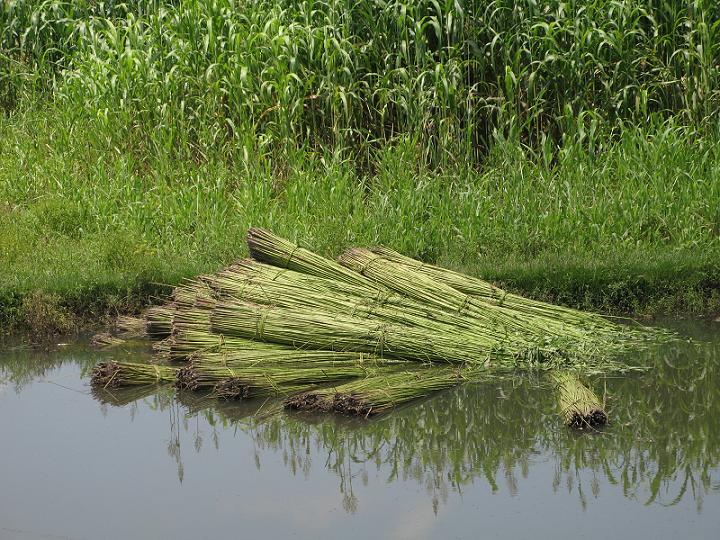
Since beginning of the harvesting season, the jute growers are being deprived of fair price
due to dominance and malpractices by the middlemen and traders gang at different hats
and bazars in the district.
Concurrently, the farmers are failing to recoup the production cost amidst the adverse
situation.
In the current season, the jute farming faced drought due to scanty rainfall that forced
the farmers to irrigate their lands to save their crop. The farmers also face an awkward
situation in rotting the jute as the ponds and beels remain dry. The merciful rainfall in late
Shravan, however, reduced their sufferings in some extent.
Additional irrigation cost and enhanced labour-cost had propelled the jute production
cost this season, farmers said. They hardly produced eight mounds of jute fiber from per
bigha of land by spending at least Taka 8,000.
On Monday last, one mound of jute was sold at Taka 1,000 to Taka 1,200 at Nawhata
wholesale market and the price is not sufficient to recoup the production cost.
Most of the farmers alleged that the middlemen and businessmen keep the jute price
reduced through syndication.
Sunil Kumar Ghosh, a farmer of Dharmahata village under Pabau upazila, says he had
cultivated jute on 1.5 bigha of land and harvested only seven mounds of jute in the
wake of bad weather. He sold the jute at Taka 1,160 per mound and couldn’t get back
production cost after selling his harvested jute, he added.
Sunil mentioned that most of his fellow farmers are facing the similar situation.
Jute farmers and agriculturists told BSS separately that the farmers cultivated jute on
12,100 hectares of land in the district this season against the target of 13,514 hectares set
by the Department of Agriculture Extension (DAE).
Expressing their grave concern over the present situation the farmers demanded
immediate interference of the government to ensure legitimate price to the growers.
Otherwise, they apprehended that the farmers may turn back from jute cultivation which,
in turn, may affect the national economy.
Ekabbar Ali of Shreepur village under Paba upazilla said the farmers in the early season
have rotten their jute plants using water from deep tubewell as all the nearby ponds,
canals and ditches remain dry due to scanty rainfall this season.
In addition to the suffering, the jute growers also had to spent more money for the
harvesting and fiber segregation purposes after facing a labor-crisis situation, he
informed.
He demanded legitimate price of jute for the sake of boosting its output through making
the farmers more interested towards the cash crop farming.
Ekabbar Ali said the jute is being sold at Tk 1,000-1200 per mound whereas the price
was Tk 1,200-1,400 in 2012 while Taka 2,000 in 2010. “The present market price is very
much less than production cost of around Taka 8,000 per bigha,” said Asad Ali, a farmer
of Tema village under Mohanpur upazila.
Abu Bakker Ai, former president of Rajshahi Chamber of Commerce and Industry, urged
the public and private sector jute mills authorities to purchase jute from the farmers
directly and at mill get instead of the middlemen.
The farmers, in large, were seen bringing jute to different hats and bazaars with the hope
of meet up their family needs by the sale proceeds. But taking advantages of the situation
the middlemen gangs are seen forcing the growers to sell their produced in less price.
In this situation, most of the farmers are failing to recover their production cost.
Abdur Rahim, a farmer of Bargachhi village, said the farmers will get fair price if the
public and private jute mill authorities were purchase jute from the growers directly
instead of the middlemen.
“If this adverse situation prolongs, the jute farming are supposed to be declined in the
years ahead,” apprehended Abdur Rahim. -BSS, Rajshahi