
Dr. Wakar Uddin
PA, USA – The present situation in Arakan is dire as the Myanmar armed forces are continuing the brutal assaults on Rohingya civilian population in Maungdaw and Buthidaung in Northern Arakan/Rakhine state. The growing humanitarian crisis in the area has further deteriorated in recent days due to the indiscriminate killing of Rohingya men, women, and children, and the widespread torching of homes in a number of Rohingya villages. Myanmar Government has reportedly evacuated all the civil servants and a large number of Buddhist Rakhine civilian population. Blockade of all the land and water routes by the Myanmar Government in Northern Rakhine state has left a number of Rohingya villages with acute shortages of food, water, medicine and other life-sustaining supplies.
The violence by the Myanmar armed forces On October 9, 2016, an armed clash between a group of Rohingya and Myanmar paramilitary border police (BGP) took place in Maungdaw North in Northern Arakan/Rakhine state. According to the accounts by the Burmese Government, 9 members of the Burmese Police Force and 8 insurgents were killed. Following the armed clash with insurgents the Myanmar Government armed forces have begun to assault the Rohingya villages in Maungdaw North. In recent days the number of casualties in both Myanmar Government forces (combined military, border guard police, and local police) and the insurgent sides became murky and turned out to be questionable. Strange and contradicting information is being released by the Government.According to sources from Myanmar and international analysts, some key Myanmar military operatives were implicated in creating the violent situation in Northern Rakhine state.
Reports from the grounds also indicate that the Rohingya insurgent group was trapped by the Myanmar military as a pretext for creating instability in Northern Rakhine state that has been relatively trouble free since the first violence broke out in 2012. The Buddhist population in Northern Rakhine state is small minority and the Buddhist Rakhine base has not been strong enough for the Myanmar military to devise a communal riot as it did in Southern Rakhine State 2012. The ultra-nationalist Myanmar military think-tank has been evidently eying the heavily Rohingya populated Townships in Northern Rakhine state; thus, launching this campaign against Rohingya civilian population with the aim of Rohingya population displacement, internally and externally, particularly to force them out to Bangladesh where nearly 300,000 Rohingya refugees in camps already exist.
Crimes against humanity
As of November 28, 2016, over 500 innocent Rohingya civilians have been reportedly killed by the Myanmar armed forces. The overwhelming number of killing of Rohingya civilians were done in summary execution and atrocities. Over 2000 Rohingya homes from 14 villages have been torched by the Myanmar armed forces. Of the 14 villages two villages were completely burnt down where not a single Rohingya home was spared.
Several families including women, young children, and toddlers were killed in open ground while escaping burning homes (attached images and video clips). Some children/toddlers were thrown into the fire by the Myanmar armed forces as the families tried to escape when the Myanmar armed forces torched their homes. Witnesses have reported that Myanmar army helicopters fired fleeing Rohingya families and killed scores of Rohingya men, women, and children. There are mounting cases of rapes. Gang rapes of Rohingya women have led to death of at least dozens of Rohingya women. In the attached video clip (in Rohingya language), the witness in a highly emotional state describes how they had to leave behind the dead body of their teenage girl in the wood as she died from extensive bleeding resulting the gang rape by Myanmar armed forces. She also describes how the Myanmar forces killed the rape victim’s grandmother brutally as she pleaded them to spare the little girl.
Arbitrary arrests of Rohingya civilians were rampant during the early part of the violence, and currently the extrajudicial arrests and summary execution is rising at an alarming rate. Myanmar armed forces made arbitrary arrests of over 450 Rohingya men who are being tortured at various detention camps. A recent report received on November 29, 2016, indicated that approximately 200 Rohingya detainees in Myanmar Border Guard Police (BGP) station in Kyigan Pyin have been undergoing brutal inhumane treatments that are extremely disturbing.
A witness who has escaped from the Kyigan Pyin BGP station narrated some horrifying events that took place in Kyigan Pyin detention camp. Myanmar armed forces reportedly have kept groups of Rohingya detainees naked in the large halls, tied their hands, and making them crawl and eat rice grains that were thrown and dispersed on the floor. Dogs were brought in and the dogs have attacked and maul some of the Rohingya detainees. A kind of waterboarding using steaming hot water have been seen by the escapee. The dead bodies of the tortured victims were disposed in the nearby wooded hills using the Rohingya detainees from the same camp.
The escapee has described the disposal of several mutilated bodies of the victims, and some were still alive as he saw their arms and legs still moving and voice could be heard as they were being removed from the building for disposal.
Instigating communal violence
While the Government of Myanmar continues to assault Rohingya villages and committing summary execution of Rohingya civilians, the Myanmar armed forces are arming the local Buddhist Rakhine population. Training camps for the Buddhist Rakhine men and women have been set up in a number of location in Northern Rakhine state. Buddhist militia groups that have been trained by the Myanmar Government have coordinated attacks on Rohingya homes in Dar Gyi Zar, U Shey Kya, and Myaw Taung in Maungdaw North.
Major humanitarian crisis
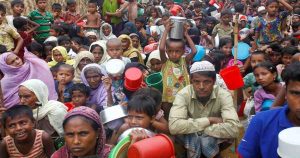
Over 30,000 Rohingya have been reportedly displaced in Northern Rakhine state in recent weeks resulting from the assaults on Rohingya villages. Most of the victims have taken shelters in nearby Rohingya villages and in forest areas while a small number have crossed into Bangladesh for safety. The Government of Burma has reportedly evacuated all the civil servants and over 4000 Buddhist Rakhine families from the area.
There is serious shortage of food, medicine, and water in Rohingya IDP camps and in Rohingya villages in Arakan. Water supplies are also limited due to shortage of wells in Rohingya areas. Winter is approaching rapidly and winter supplies such as blankets and protective clothing are needed urgently. In Maungdaw North, almost all the host Rohingya families in nearby villages providing shelters to the victims are subsistence farmers and day laborers that could no longer take care of the victims because of their extreme economic hardships under the current condition. Further,

Buddhist settlers from the government-built settlement villages and Myanmar armed forces have looted grains from the silo storages in Rohingya villages and they are currently harvesting this season’s crop from Rohingya farmlands. Additionally, sprouting and deteriorating of grain crops are reportedly widespread as the Rohingya farmers cannot even cannot get access to their fields due to the violence threat from the Buddhist settlers.
(Dr. Wakar Uddin is Director General, Arakan Rohingya Union, a global Rohingya umbrella organization representing 61 Rohingya organizations worldwide, was formed under the patronage of the OIC Secretary General (38th OIC-CFM Resolution No.4/37-MM) as a united Rohingya coordinated council to reclaim the rights of Rohingya people in their homeland. Arakan Rohingya Union is registered in the United States and recognized by the 57 member states of OIC as the official representative organization of the Rohingya people.dg.aru@ar-union.org; www.ar-union.org)