Dan W Mozena
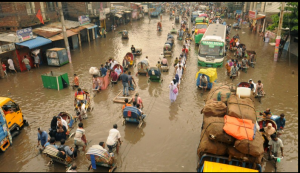
All know that Bangladesh is among the nations most impacted by global climate change. Rising sea levels threaten huge swaths of the nation, much of which is only a few meters above sea level.
Thanks in good measure to you and your success in alerting the nation to the challenges of global climate change, Bangladesh is tackling head-on the challenges of climate change.Confronting this challenge is a high priority for America. At the UN General Assembly in September, President Obama said, “The challenge (of global climate change) demands our ambition. Our children deserve such ambition. And if we act now, if we can look beyond the swarm of current events and some of the economic challenges and political challenges involved, if we place the air that our children will breathe and the food that they will eat and the hopes and dreams of all posterity above our own short-term interests, we may not be too late for them.” Secretary Kerry, too, has made climate change a key priority of his foreign policy agenda.
I am proud that America is Bangladesh’s partner as this great nation confronts the challenges of climate change.
Funded at about $lO-$15 million a year, our climate change partnership with Bangladesh promotes clean and sustainable development while addressing the potentially devastating impact of global climate change. This partnership has so many facets.
We help Bangladesh engage with local communities to change their relationship with the ever- threatened forests to provide a stronger
buffer for the nation from the rising levels of the Bay of Bengal. Thanks to this partnership, local communities now understand better
than ever that preserving these forests and their rich animal and plant life is essential to safeguarding the well-being of the
communities in the future.
These programs are already paying dividends in reducing pressure on critical buffer zones as local communities take the lead in protecting these rich assets.
America’s partnership with Bangladesh engages with factories to encourage them to adopt safe, clean, and climate friendly practices.
We work closely with the government agencies to strengthen the regulatory climate, to increase energy efficiency, and to promote
clean energy development.
One of our most promising programs promotes access to power for all Bangladeshis by bringing power from renewable energy sources to rural communities that are nOt connected to the grid.
We support some of the most exciting, cutting edge work being done with solar power and the development of self-sustaining nano-grids that bring meaningful electrical power to homes that once were dark.These technologies promise to bring light to millions of families both here and around the world. These technologies also promise to revolutionize irrigation across the countryside.
Our partnership engages in so many other areas: planting trees to increase the nation’s tree cover; introducing fuel efficient cook
stoves to reduce pressure on the forests and slash air pollution; reintroducing traditional practices of raising homesteads by using
dirt dug out from constructing fish ponds; developing and disseminating saline-tolerant, drought-tolerant and flood-tolerant
seeds; introducing new ways to apply urea and fertilizer to reduce both run-off and air pollution; assessing potential for using wind
power to generate electricity; buildiig 130 more cyclone shelters during my tenure, and so much more.
I am so proud of America’s partnership with Bangladesh in helping the people of this country prepare for and cope with the effects of
climate change.
I wish to speak briefly of environment from another perspective. As I travel about Bangladesh, I am impressed by the work being done by the private sector to reduce the impact of industry on the environment. I have visited one of the largest apparel dyeing
facilities in Asia and saw the effluent treatment plant there that cleans the wastewater so it is safe for irrigation and release into
the environment.
Also, I am encouraged by the work the government and tannery industry are undertaking to build a new tannery park in Savar.
Once these new, environment-friendly tanneries come on line, Bangladesh will have access to American and other markets for
exporting shoes and finished leather goods. I believe someday these exports will rival apparel as drivers of Bangladesh’s exports.
Similarly, amazing things are happening in the pharmaceutical industry, which, too, is developing in an environmentally friendly
way, thus opening the door for Bangladesh to become a massive supplier of generic pharmaceuticals to America and beyond.
Bio-tecbnology is another front where Bangladesh is making progress in both the private and public sectors in reducing damage to the
environment from agriculture. Conventional brinjal in Bangladesh is often sprayed with pesticides over 80 times during a growing season; Bt brinjal, in contrast, is sprayed only once or twice, if at all. In my home state in America, cultivation of bioengineered crops has slashed the use of pesticides, resulting in a resurgence of birds and wildlife.
(Remarks made by US Ambassador to Bangladesh Dan W Mozena at a press briefing arranged by the Forum of Environmental Journalists of Bangladesh FEJB marking its 32 years of founding at the National Press Club on Sunday.)