Bahauddin Foizee
The uneasy and unbearable weather conditions in many parts of the world have become the new trend of our planet’s environment, causing the coastal areas across the globe to gradually submerge under water. While such environmental deterioration is an adverse effect of global warming, the phenomenon is in turn caused by several contributory factors, including the increasing trend of worldwide militarisation.Military rivalries are pushing rival states to make a thrust for unprecedented and unchecked militarisation of different geopolitical hot-spots of our globe and to produce, acquire and use destructive weapons and other military hardware for conflicts and wars that are causing environment of our planet to deteriorate drastically.
IMPACTS BEYOND BORDERS: As borders between states are unable to stop the effects of environmental deterioration from spreading from one country to another and from one region to another, the environmental impact of military hardware production, wars and conflicts in one part of the globe are reaching the far-away victim countries in another part of the globe, making the weather conditions of the victim countries deteriorate severely. Thus, the wars around the globe have been seriously impacting natural environments of not only the war-torn countries, but also most of the countries around the globe.
HARMFUL GASES: The production and utilisation (in war zones) of military hardware, including weaponry and military vehicles, require heavy consumption of fuel energy like coal and oil.
Consumption or burning of fossil fuels release into the air millions of tons of harmful and poisonous gases that have been previously locked up in coal, oil and natural gas for millions of years. Such harmful gases include carbon dioxide, carbon monoxide, nitrogen oxides, hydrocarbons and sulphur dioxide – all of which are immensely injurious to our planet’s environment.
Air pollution from production and utilisation of military hardware has, over the years, adversely affected human health. Increase in cancer, birth defects, and other adverse health conditions are associated with war-related environmental damage.
RISE IN TEMPARETURES: The major environmental impact of growing worldwide militarisation is the gradual rise in average global temperatures, which further poses a number of threats: (i) threat to human health increases by many times, (ii) ecosystem is damaged due to higher temperatures, (iii) changing weather patterns cause irreversible damage to agriculture, (iv) coastal areas are vulnerable to the lethal combination of rising sea level and increasing number of severe ocean storms that are caused by the melting of mountain-ice and polar glaciers.
COASTAL AREAS SUBMERGE UNDER WATER: The effects of the continuation of the rise in sea-levels are deep. Sea-level rise has been causing more floods, especially during storms. Higher sea-levels have increased the size of the flow of water that the super-storms generally bring into inland from the ocean. Some short-term impacts of rise in sea-level are regularly experienced these days by many inhabitants around the globe. The Tsunami is an ideal example of what sort of disaster the rise in sea-level could lead us up to.
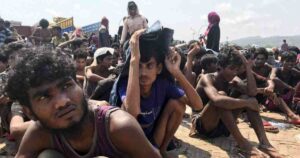
Because of the rise in sea-levels, many areas around the globe (especially the coastal ones) have gradually been submerged under water. Perhaps it will not take decades for the existing global coastlines to disappear, turning millions of inhabitants living in those coastal areas into climate refugees.
AN ILLUSTRATION: Here is an illustration of the connection among militarisation, rise in temperatures, sea-level rise and disappearance of coastal areas into water:
In Syria, the use of bombs and heavy weaponry by all warring sides has been, in effect, releasing harmful gases into the air, causing rise in temperatures. Similarly, harmful gases are being released into the air by the artillery firing and missile attacks in Yemen and Ukraine, which too causes rise in temperature. Such rise in global temperatures causes the melting of the polar ice in Arctic and Antarctic regions, making the coastal areas in Bangladesh, Myanmar and Thailand vulnerable to the rising sea level.
Already Bangkok (Thailand) has been sinking 10 centimetres every year, placing the city at risk of submerging into the sea within a matter of few decades (according to Thai Committee of National Disaster Warning Administration). There is the possibility that 6-8 per cent of ‘flood-prone’ Bangladesh may be submerged under water by 2030 (a prediction made in 2007 by the UK Department for International Development). As for Myanmar, a substantial portion of the country’s coastal areas is predicted to be submerged under water by 2050 (as per the 4th assessment report published by the International Panel on Climate Change).
OBSERVATIONS: German scholars from the Potsdam Institute for Climate Impact Research (PICIR) warned that if incentives of the global warming are not reduced immediately worldwide, a series of unstoppable events will be triggered, causing dramatic rise in sea-levels and the total annihilation of coastal areas inhabited by millions of people.
Therefore, taking the PICIR’s warning into consideration, it may well be suggested that the countries, which are the major victims of environmental deterioration, should make sure that the increasing trend of worldwide militarisation is reduced, since militarisation is one of the major incentives of global warming.
There should be a united global effort on the victim countries’ part to pressurise the regional and global military powers to tone down their increasing trend of militarisation at home and abroad. Otherwise, millions of coastal inhabitants around the globe, especially in countries like Bangladesh, would face a survival threat.
The writer, primarily associated with law practice, is an international affairs columnist. foizee.bahauddin@gmail.com – World News Report via EIN News