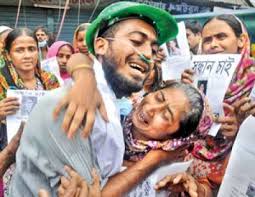
Citizens groups, workers organisations at a programme here on Saturday expressed dissatisfaction over the lack of information on the dead and the survivors of the Rana Plaza collapse.They raised complaints about the lack of information on the delivery of commitments made by the government, foreign countries, international buyers, and local owners to compensate the survivors and relatives of the dead workers.
They demanded all the responsible agencies to come up with an account of what they have already done to compensate the workers and the relatives, and also stressed forming a central body to monitor the delivery of the commitments already made.
The observations came at the launching of a report, titled ‘100 Days of Rana Plaza Tragedy: A Report on Commitments and Delivery’, prepared by the country’s leading think tank Centre for Policy Dialogue (CPD).
The programme was organised by CPD at Cirdap auditorium. In his keynote presentation on the report, CPD additional research director KG Moazzem noted that there is no updated information about the progress of the commitments made by international retailers, although H&M, Inditex, Primax, C&A committed to disbursing US$ 5 million for the families of the victims.
No progress is known about the commitment made by the companies which took orders from the factories housed in Rana Plaza, he added. Moazzem also noted that hospitals and clinics have already started charging fees and costs of medicines for the workers requiring long-term treatment.
“The government’s commitment for a two-year support to the injured workers should consider the factor that many of the injured workers have to be unemployed for years to come.
The government should immediately disclose its plan to ensure long-term treatment facilities free of costs,” he said. The families of those whose dead bodies are yet to be identified are in the most hapless condition, said Moazzem, noting that a total of 332 dead bodies are yet to be identified.
Speaking on the occasion, president of Bangladesh Garment Workers’ Trade Union Centre Montu Ghosh said the actual number of the workers who died or were injured is being concealed by the Bangladesh Garment Manufacturers and Exporters Association (BGMEA), although it has the list of the workers of the factories housed in Rana Plaza.
He also complained that people are in the dark about the reports or the progress of the investigation of the committees formed by the government and the BGMEA to find out the causes and compensation of the Rana Plaza Collapse.
“We’ve learnt that funds are coming to support the victim families as well as to work on improving the safety standards of the factories through different channels. But we aren’t clear how the money is being spent,” he said.
A committee with representatives from workers must be formed to monitor the interventions, he recommended. “The government, the BGMEA and the foreign stakeholders are also working on improving the safety standards and for ensuring the rights of the workers. But the workers representatives are not made parts of these initiatives,” he said adding, “How the workers problems can be solved without soliciting the workers.”
Ain O Salish Kendra chairperson Hamida Hossain also recommended involving the workers in the monitoring of the implementation of the post-Rana Plaza collapse rehabilitation. “There should be a tripartite system of monitoring,” she said.
BGMEA’s former president Shafiul Islam Mohiuddin said his association has the information about the number of workers of the factories involved and is ready to cooperate with any agency interested to support the victim families.
CPD chairman Prof Rehman Sobhan observed that the readymade garment (RMG) industry of the country is operating in a globalised market system — the system is functioning by the principles of cost-cutting.
Can the safety in the RMG sector of the country be ensured in the globalised competitive market, the noted economist asked. “At the end of the day, global competitive market will go on as it was,” he said.
Pointing out the factor that Bangladesh is only getting US$5 for making a shirt for New York-based retailers like Walmart, while the retailer is getting US$ 25 from selling it to the consumers, Prof Sobhan said, “We need to also get accountability from the people who are appropriating 25 dollars.”
BNP chairperson’s adviser Amir Khosru Mohammad Chowdhury said the regulatory oversight on the industry must be strengthened to ensure the standards in the RMG sector in the longer run. “Governance is a very serious problem and it will take time to improve the regulatory oversight.
But in the meantime, BGMEA should self-regulate itself to improve the conditions,” he said. Speaking as the chief guest, Commerce Minister GM Quader said the government has formed different committees to address the problems of the RMG sector, including the burning issue of the compensation of the victims of the Rana Plaza Collapse.
The government is going to launch an action programme matrix very soon to coordinate the interventions, he added. – UNB